

Anna Burnside reviews ‘a taster menu of new material and different styles of dance’ that proves to be ‘a fascinating success’.
Dancers, like professional footballers, have a time-limited career. There are exceptions - go Charlotta Ofverholm in Scottish Ballet’s Mary Queen of Scots - but it is still largely a job for the under-40s.
In 2022, soloist Jamiel Deverney-Laurence retired from Scottish Ballet, with the grand ambition of widening the audience for dance and giving artists at all levels new platforms and opportunities.
The result is Ballet Nights, a touring showcase of established dancers, newbies and students. By mixing contemporary dance and classical ballet on one programme, there’s cross-pollination between genres and exposure for less familiar practitioners.
Deverney-Laurence introduces and sets up each segment - 11 in Glasgow - in the style of a dance nerd who secretly wants to be a stand-up comedian. There is much made of the biggest name on the bill, Royal Ballet soloist Harris Bell, being from Dollar.
Or, as Deverney-Laurence calls it, “Dollar Scotland”.
Bell is joined by his wife, Royal Ballet senior soloist Sae Maeda, to open the show with the “Moszkowski Waltz”, a short exhibition dance full of showy lifts and stagey interactions.
If that feels a pirouette round the past, recent Rambert graduates Chrysanthi Nikolaou and Django Bates-Blower are very much of the now. Their self-choreographed piece, “Atlas”, has Rambert dynamism and compulsion set to German electronic composer Ori Lichtik’s propulsive beats.
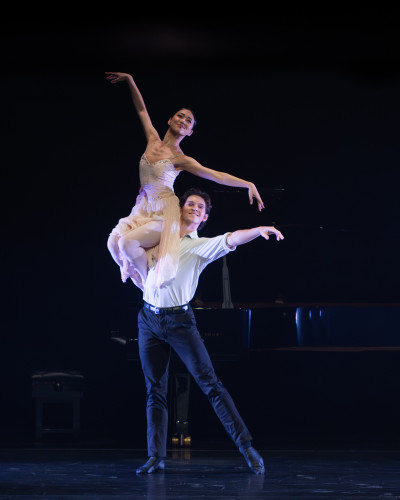 Another young pairing, Travis Clausen-Knight and James Pett of PCK Dance, bring wistfulness and yearning into the final duet from their Eden Court show “Imago”. The Max Richter score, performed live by pianist Viktor Erik Emanuel and violinist Anna Brown, dials up the melancholy.
The second half includes Guy Salim’s unaccompanied tap clickathon “Temperature”, an enigmatic piece inspired by the aftermath of a nuclear holocaust, performed by Liam Woodvine and Taylor Hughes connected together through gas masks and a throwback to the start of Scottish Ballet with an excerpt of Peter Darrell’s “Cheri”.
It ends with Bell and Maeda showcasing their classical chops in the act three pas de deux from Sleeping Beauty. The many teachers in the audience nod approvingly as Bell performs more lifts than Stanna while Maeda embodies the grace and delicacy associated with the origins of the dance form.
Some elements of Ballet Nights worked better than others. The lighting was clunky and the volume of some of the recorded music too high. But as a taster menu of new material and different styles of dance, it was a fascinating success.
Ballet Nights performs a bespoke performance at the Theatre Royal Glasgow until 3 September 2026. It performs at the Usher Hall in Edinburgh 16 February 2027. For further details, go to the production’s website.
Photo by Rimbaud Patron.

 RSS
RSS