

Scott Purvis-Armour reviews a production that’s ‘never heavy but somewhat overwhelming’.
When the smoke of the Second World War settled and a haze of suspicion left European governments in a Cold War, the spy novels of John Le Carré and Ian Fleming gave the world a Double-O vision of what happened behind the bulletproof armour of British Intelligence: whilst Fleming’s Bond sexily blasted impossible lasers at impossible supervillains, Le Carré dusted off the daily drudgery of MI6 with a psychological deftness unparalleled in spy thrillers.
More bureaucratic reportage than semi-automatic weapon espionage, this adaptation of The Spy Who Came in from the Cold is never heavy but somewhat overwhelming. The first twenty minutes of exposition feels like two-hundred pages of fiction: what on the page might tick along as gently and suspensefully as an unexploded bomb feels like overly-explanatory, a Russian doll of new complications and new opportunities for betrayal in each scene which perhaps inadvertently reveals too much, defusing mystery.
When the theatre’s iron curtain raises on the second act of the theatrical Iron Curtain, the piece becomes more enjoyable, much less like an exam in remembering who wants to poison who. The action becomes more relaxed, allowing David Eldridge’s adaptation to explore the mysteries of the first act less implicitly, culminating in an entertaining sequence of interrogations, courtroom revelations and a climax plot which finds the most meaningful moment of emotional engagement in the production. Shakespearean, not stirred.
Under the harsh spotlights of Azusa Ono’s lighting and against Paul Englishby’s knife-blade violin compositions, Jeremy Herrin directs the supporting cast to increase tension well as the piece progresses. There’s a knowing sinisterness in Tony Turner’s omniscient George Smiley and an intelligent air of Intelligence in Nicholas Murchie’s Control. But it is Gràinne Dromgoole who gives the performance of the evening, navigating the difficulties of portraying a woman in the ageing genre without cliché and with heart.
Royle Family star Ralf Little was altogether less comfortable as the shouty, dislikable and mercurial Alec Leamas. His naturalistic acting seems particularly out of place amongst the Received Pronunciation of his jolly-marvellous-old-chap Oxbridge co-stars. Although there are some quiet moments of tenderness, the “blood, guts and cricket” register of the character feels written more for a burnt-out Ralph Fiennes performance than a boyish Ralf Little. It isn’t his fault; it just isn’t his genre.
As a consequence, the agent’s story feels a bit dull and… well… missionary. The name’s Bored. James Bored, and when it ended there seemed to be a feeling that the audience left without a Le Carré in the world for what became of its protagonists.
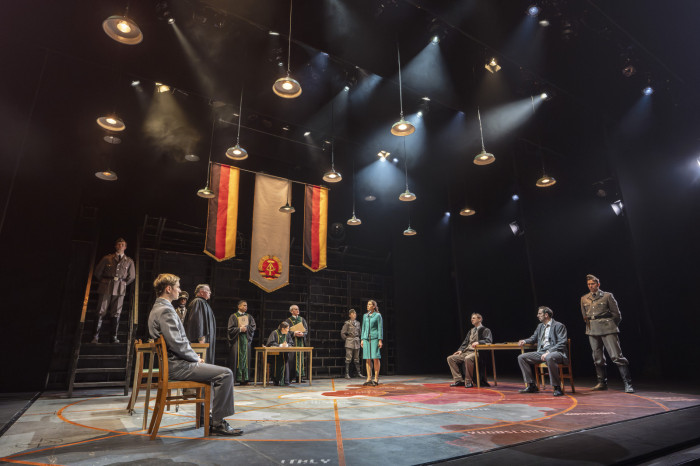
The Spy Who Came in from the Cold has finished its run at Glasgow’s Theatre Royal. It continues to tour England until August 2026. For further details, go to the production’s website.

 RSS
RSS